I can't trust what AI tells meOur last pilot went nowhereWhere would AI even fit in my business?Our data is a messImported equipment never quite fits how we workI can't afford a prototype that fails in productionWill it replace my people?I can't trust what AI tells meOur last pilot went nowhereWhere would AI even fit in my business?Our data is a messImported equipment never quite fits how we workI can't afford a prototype that fails in productionWill it replace my people?
About
Welcome to ARM Hub
ARM Hub is an independent, not-for-profit AI and robotics centre in Brisbane. It exists to help Australian businesses use advanced technology to compete.
Large enterprises can struggle to keep pace with fast-moving technology. Small and medium businesses, which make up more than 99 per cent of Australian businesses, are often more agile. But most cannot afford in-house data scientists or robotics engineers.
ARM Hub provides that capability as a service across three pillars: Data and AI, Robotics and Vision Systems, and Engineering for Scale. The Australian Government appointed ARM Hub as one of four national AI Adopt Centres, and it coordinates a network of 28 partner organisations.
The goal is adoption, not experimentation. ARM Hub works with a company to find one problem worth solving, trains the people who will use the system, then deploys it on the floor.
Manufacturing is in our DNA. The factory floor judges work on deliverables, deadlines and accuracy, all measured in physical output. Automation in this environment demands planning and care, and every innovation must earn its place.
Successful implementation on the factory floor teaches lessons that apply to any business. At their foundation, AI and automation are straightforward. The technology is the easy part. Choosing where to apply it, and getting your systems and people ready, is the real work.
Whatever your size, goals or challenges, there is an automation opportunity that can improve outcomes. We hope this summary makes that first step a little easier.
Mike Woodcock Communications Director, ARM Hub September 2026
Change made easier
Derisking automation in your business.
Most Australian businesses can see where new technology might help. The harder part is the risk of getting it wrong, and that risk looks different depending on what you're adopting.
For AI tools, the worry is trust. The National AI Centre tracks adoption every quarter. Its latest data shows around 65 per cent of businesses that have yet to adopt AI cite distrust of AI decision-making, or a preference for keeping humans in control, as the reason. It is the single largest barrier, and it holds across industries, business sizes and locations. Deloitte found two thirds of businesses use AI in some form, but only 5 per cent are set up to get its full benefit. UTS researchers found around a third name their own understanding of AI as the barrier, and nearly one business in five does not know where to start.
For machines and hardware, the worry is money. A prototype that works in the workshop can still fail on the production line. Automation bought from overseas is built for plants that run one product all day, and most Australian plants don't work that way. Making it fit takes time, cash and specialist help that small businesses rarely have on hand.
The same questions sit under both. Is our data good enough? Will the project stall halfway? Who looks after it once it's built? And, more and more: what happens to our people?
These are fair questions. Nobody should hand a safety decision to a system they cannot check, or commit to building 50 units of a product that has never been built twice (or even once).
The businesses in this document found that a small, well-chosen first step answers most of those questions before much money is spent.
None of them began as experts. They are a contractors' association, a road safety manufacturer, a diagnostics company, a tissue engineering company, a real estate agency and a First Nations consulting firm. Alongside their stories, four people who do this work every day explain what gets projects over the line.
Each story carries a panel that names the concern, what the evidence showed and what to take away. Start with the worry that sounds most like yours.
Start with the worry that sounds most like yours
“I can't trust what AI tells me.”AMCA. Answers built on documents you have already approved are answers you can trace.Read →
“Where would AI even fit in my business?”Where AI Actually Works. Map your workflows and build the easiest valuable one first.Read →
“Our data is a mess.”Microbio and yamagigu. Structure the data first, and the tools get cheaper.Read →
“Imported equipment never quite fits how we work.”Dr Troy Cordie. Automation built on local data fits from the start.Read →
“I can't afford a prototype that fails in production.”ProTx. Design for manufacture from day one.Read →
“Will it replace my people?”In every story here, the technology flags and people decide. The hours it saves go back into work that earns money.Read →
Sources: National AI Centre, AI adoption insights Dec 2025–Feb 2026 (ai.gov.au/news-and-insights/blog/ai-adoption-insights-december-2025-february-2026); Deloitte Access Economics, The AI edge for small business, Nov 2025 (deloitte.com/au/en/about/press-room/ai-edge-small-business-increased-smb-ai-adoption-can-add-44-billion-australias-economy-251125.html); UTS Human Technology Institute / Safe AI Adoption Model, saam.com.au.
04 · Impact Study · AMCA
Reduced downtime, safer workspaces
The Air-conditioning & Mechanical Contractors Association of Australia (AMCA) represents more than 130 businesses that install and service commercial heating, ventilation and air conditioning. It's a highly regulated industry, with both state and federal oversight. On any given day, a manager or worker may need to check a procedure, confirm a control measure, or interpret a regulation before starting a task, and getting it wrong can be costly.
Most AMCA members are small contracting businesses, where safety responsibilities are shared across multiple roles rather than assigned to a dedicated safety manager. The knowledge they rely on is typically dispersed across lengthy manuals, policies, and regulatory documents, making critical information difficult to locate when it is needed most.
For AMCA, supporting the safety and success of its members is central to its mission. With this goal in mind, the organisation partnered with ARM Hub to develop a better way of making essential safety knowledge readily accessible via its Integrated Management Systems (IMS), ensuring that managers and workers can quickly find reliable, up-to-date information whenever and wherever they need it.
In late 2025, AMCA commenced work with the ARM Hub AI Adopt Centre to co-develop relevant solutions. This resulted in the creation of two complementary AI-powered tools: the AI OHS Assistant and the AI SWMS Generator. Together, they are transforming how AMCA members access standards, procedures, and templates by providing accessible, real-time support that helps them make safer, faster, and more informed decisions.
Through the ARM Hub AI Adopt Centre, AMCA has transformed decades of safety, quality, and environmental expertise from static manuals and procedures into an interactive safety management system that provides governed, traceable, real-time guidance to member businesses, extending AMCA's ability to deliver trusted knowledge at the point it is needed most.
AI OHS Assistant
A conversational chatbot that gives AMCA members instant access to trusted safety and compliance guidance. Workers can ask questions in plain language, just as they would speak to a supervisor, and receive clear, concise answers.
AI SWMS Generator
Streamlines the creation of Safe Work Method Statements by guiding users through a structured, step-by-step workflow that combines AMCA approved content with company details, project information, and site-specific hazards.
“
What we are developing gives our members instant, reliable guidance that keeps them compliant and takes the guesswork out of an area that genuinely keeps people up at night.
Ben HawkinsCEO, AMCA
20,000+HVAC workers in the sector working on construction sites that require better access to Safe Work Method Statement (SWMS).
Up to90%reduction in time to produce a compliant Safe Work Method Statement (SWMS) document – from four hours to under 15 minutes.
3000+safety queries expected per week across active member companies at current adoption.
400+Safe Work Method Statements expected to be generated each month using AMCA-approved content and tailored to the specific task and site conditions.
LESSONS
The concern
Getting safety or compliance wrong under pressure, and having poor documentation exposed after an incident.
The evidence says
Answers built on your own approved documents are answers you can trust and trace.
The take away
You don't need to trust “AI.” You just need to make your own information more accessible in the field and on the fly.
06 · Article · Corrie Germin
After the pilot: why AI projects stall
(and what it takes to get them into production)
Corrie Germin, Director of Industry Programs, ARM Hub
Corrie Germin has spent more than 20 years helping businesses and governments make investment decisions about technology, infrastructure and economic development. With a background in senior investment and delivery roles across the NSW Government, including at NSW Treasury, Germin, CG to his coworkers, now leads programs and commercial activity at ARM Hub. Here we explore with CG what AI implementation actually means within the context of a complex business.
In late 2026 the central question in an artificial intelligence project is no longer whether or not the technology ‘works’. The central question now is whether the organisation can absorb it. Germin learned that on a job that looked like a technology problem. One of the largest federal government departments in Australia needed a new digital identity policy and the infrastructure to support it. The end goal was to make various sections more digitally savvy, and to better enable frontline workers to access data when interacting with clients.
“Technology transformation was the easy bit,” Germin said. “Changing culture internally was the biggest challenge.” Germin has since sat on both sides of the approval table. From 2020 to 2022 at NSW Treasury he negotiated 45 capital investment grants for domestic and international business expansion. The program was designed to secure 5000 direct jobs and 20,000 indirect jobs over four years, as part of a $500 million program designed to uplift businesses post COVID.
Delivery, in both settings, depends on more than a sound technical proposal. “Large manufacturers face uncertain geopolitical and supply chain challenges when making investment decisions around automation and robotics,” Germin said. “The return on investment varies by sector and manufacturing activity.” That uncertainty makes the investment process as important as the technology itself.
Germin advocates staged projects with clear milestones and “go/no-go checkpoints” through feasibility, research and development, and construction.
What works, and what doesn't
For businesses moving from early concept to prototype, this process allows investors and customers to build confidence over time. “Really early concepts moving to prototype design and validation have many unknowns and require trust,” he said. “A phased and staged approach is the best way to show value and build trust over time.” The most attractive projects tend to have three things in common: a clear operational purpose, limited integration requirements and a visible human benefit.
“Projects that can scale quickly and show seamless integration in a workflow, or solve a human problem, will always get prioritised,” Germin said. “Often it's in systems that address health, safety, comp claims, or so on.” Moreover, these projects can demonstrate value quickly, with a typical payback period of less than three years from the upfront capital investment.
Getting started
The first questions to ask are simple. “How accurate is your data, do you trust your current-state dashboards, and how many software systems do you rely on to maintain healthy operations?” says Germin. The answers illustrate whether the organisation has the foundations for a useful AI system.
Beyond that moment, Germin says the next critical layer is even simpler: cultural. “The strength of the use case, how broad or narrow the problem statement is on the use case is critical. But so is whether or not the team and the culture can change to meet the needs of the AI tool.”
These questions expose why many pilots fail to become business-wide deployments.
Germin's example is an agricultural technology company that wanted to replace low-skilled labour with collaborative robots capable of performing multiple tasks. The technology was available, but the organisation still needed workers with intermediate skills to intervene and manage the system.
“Technology was available, but culture and upskilling stalled the delivery,” Germin said. The solution required a longer program that included training and education.
This is also where Germin's experience in government shapes his approach. Public programs must demonstrate value for money and social benefit, while commercial projects are usually assessed primarily through their effect on profit.
Understanding both perspectives can help businesses navigate funding and delivery requirements, he said, particularly in manufacturing, where companies may have limited experience with government programs.
What to watch
Germin is also prepared to advise clients to stop. If expectations were not agreed during scoping and discovery, the project can drift during delivery until there's no longer a shared definition of success.
“Establishing clear performance goals, and testing those along the development phase, require hard conversations,” Germin said. “If not agreed, expectations take over and both the delivery team and client are unhappy. This is when you pull the plug.”
For a CTO or a chief financial officer seeking certainty, Germin does not promise more than the evidence supports.
“For concept and prototype design and delivery, the reality is we don't know,” he said. The answer is to set expectations and negotiate milestones that build confidence about the total investment required.
He said an early prototype and validation phase might represent about 25 per cent of the total investment. After that stage, a business may be able to reach more than 90 per cent confidence about the cost of full implementation.
The bigger picture
Six months into a well-run multi-year research and development program, ARM Hub aims to have a working prototype tested and validated, with the client ready to consider a customised design and build and about 95 per cent confidence in the full cost, return on investment and ongoing support. Six months into a badly run one, Germin said, the client is unsure the prototype will work at scale or what the total investment and time will be.
“In these instances, you are constantly returning to scope, trying to realign expectations and spend time and money on the wrong solutions.”
Australia's adoption figures depend on what gets counted. The Australian Bureau of Statistics says 12 per cent of businesses used AI in 2024–25, including 35 per cent of large businesses, 22 per cent of medium-sized businesses and 11 per cent of small and micro businesses.1
The National AI Centre found that 43 per cent of Australian SMEs reported some level of AI adoption between December 2025 and February 2026.2 The figure comes from a different survey and methodology, so it should not be treated as directly comparable with the ABS result. Smaller businesses are worth watching here because they are often microcosms of the same data, culture and integration problems larger organisations face at scale.
Research from Deloitte found that 28 per cent of Australian respondents had moved at least 40 per cent of their AI pilots into production. The same survey found that 61 per cent reported improvements in efficiency and productivity, while more than half identified talent and skills gaps as a significant barrier.3
The figures suggest Australian businesses are experimenting with AI and seeing some gains. The harder work of integrating it into reliable operations remains unfinished.
When a manufacturer walks away from an automation project, Germin's explanation is short.
“They are not ready operationally, or they simply choose not to solve the problem at all, and kick the problem down the street for a later date,” Germin said.
The problem does not go away while it waits. It just gets solved by someone else first.
“
Technology transformation was the easy bit. Changing culture internally was the biggest challenge.
Corrie GerminDirector of Industry Programs, ARM Hub
LESSONS
The concern
“Our last pilot went nowhere.”
The evidence says
Pilots stall when the problem is too broad, expectations aren't agreed to or the team isn't ready to change how it works.
The take away
Run the project in stages, with go/no-go checkpoints agreed before work starts.
1 Australian Bureau of Statistics, “Business adoption of Artificial Intelligence accelerates in 2024–25,” released 25 June 2026. 2 National AI Centre, SME AI adoption tracker, December 2025 to February 2026 quarter. 3 Deloitte, “State of AI in the Enterprise: The Untapped Edge,” 2026. Australian findings released 12 February 2026. Survey conducted August to September 2025 among 3,235 director to C-suite leaders across 24 countries.
08 · Interview · Dr Roozbeh Derakhshan
Balancing machine and human: Where success lives
Roozbeh Derakhshan, Director and Founder, DKE
Dr Roozbeh Derakhshan has spent his career on the delivery side of data and AI. Roles include principal senior data scientist at a tier 1 mining company, roles at a technology vendor, and a consultancy delivery organisation of about 50 people. He is founder and director of Data & Knowledge Enterprise (DKE) and has been AI Lead at ARM Hub since 2021. We asked him what stops enterprise AI projects reaching production, and what the ones that get there have in common.
When a large organisation first sits down with you, what are they actually worried about?
For organisations that have already invested, the question is often: “We have hired people and spent the money. Where is the return?” There is a mandate, a team and plenty of activity, but the AI capability is starting to look like a cost centre. They want to know how that investment will become useful to the business.
For those yet to start, the concern is timing. They wonder whether the technology will soon be cheaper or easier. I understand that hesitation, but waiting does not build the experience they need to make better decisions.
Why do enterprise AI pilots stall?
Often, the sponsor and the people expected to use the solution are not connected. A technical team builds something without enough executive support, or an executive commissions AI without involving the people whose work will change. The technology may work, but its place in the business is unresolved.
Another gap appears after deployment. Keeping a solution useful requires ongoing work, yet the funding and attention can end at delivery. You have to treat it as a product, with ownership, maintenance and improvement.
What is in place on the projects that do make it through?
Executive backing together with involvement from the people doing the work. They also have a clear route from an idea to a proof of value, and then to a separately scoped delivery project.
At a major technology vendor, I led a data platform from initial build into production, processing petabyte-scale data volumes each week and reducing compute costs by around 40%. That is why I look beyond whether a demonstration works. The operating cost and the ability to support it are part of the business case.
When we spoke earlier you described a system for deciding which ideas got built. How did it work?
At a Tier 1 mining business, they ran this concept of proof of value. Everybody was running with a cool idea, and they said, all right, we listen to all of you, but we need to run a proof of value. If the business justification is there, then that solution gets qualified to be implemented. We are not just running everything because you are excited about it.
There was a pre-filtering. If something was no good altogether, they would kill it right away. But rather than arguing with people that their idea is bad, they would run a simple version of it. Then they would go back to the user and say, is this what you are going to have, this is what the end looks like. Through that they worked out the feasibility study, the ROI, the cost benefit. If it passed all of those gates, it would be qualified to become a solution used internally across the business.
Why run the simple version rather than just say no?
Because otherwise it is too abstract. We are fighting over abstract things in AI. As a technical person you are talking about something, the business is talking about something else, and at the end of the day the reality looks very different.
So we get to a demoable version, and the people who are going to work with these solutions, who often are not the executives but the people below them, can get their hands on it. And they say, okay, I don't think this is going to add much value. Sometimes they even hold their own ideas back. They say, sorry, that is not what I want. Then they can go and refine it and come back with another brilliant idea in two or three months.
The idea is to cherish the fact that everybody thinks AI can help them come forward. But not everybody goes through the gate.
What does “proof of value” actually mean, given how loosely the term gets used?
For me, a proof of value means starting with an agreed business outcome, a limited commitment and a decision about what evidence would justify going further. Calling something a proof of value is not enough; there has to be a decision attached to it.
Agree how it will be judged, then make the decision when it ends. Proceed if the evidence supports it. Stop if it does not. The willingness to stop is as important as the willingness to scale.
What is the clearest proof of value you have seen?
There were many, but one was for a procurement team. They had invoices coming in, and the machine was reading all of those invoices, summarising them and creating the entry in the system. There was a human gate as well, so a person sat there, looked at it and entered it.
Another was a load and haul operation in a mining company. We were looking at all the stats coming at us in real time, trying to identify the alerts where the trucks are too much in line. Sometimes you are over-resourced in one place and under-resourced in another.
Each of those trucks brings roughly $200,000 revenue a day. So if I am using two trucks in the wrong place, I am losing almost half a million dollars a day. Spotting that and doing something about it is a clear proof of value.
Who in a client organisation is usually most resistant, and are they wrong?
One source of resistance I see is people who have watched previous tools go stale. It might have been a dashboard or an analytics project. Something was delivered, but nobody kept looking after it. Their scepticism about the next investment is understandable.
We need to explain who will own the product and how it will stay useful. Asking people to trust that the money will eventually produce value is not enough.
What do you look at first when an organisation says its data is a mess?
I have worked on this at different scales, from real-time data pipelines in mining to AI adoption with smaller manufacturers. The scale changes, but my starting question is the same: what information does this particular business decision need, and can we make that information reliable enough to use? “Our data is a mess” is too broad to act on.
Our approach is to build the data foundation incrementally. Once a use case has passed the initial assessment, we bring in the data it needs, improve its quality and connect that work to the people providing and using it.
Is there a size of mess where you tell them not to start yet?
Size alone does not matter. Missing information can be a more fundamental obstacle.
In manufacturing, we see businesses that want to forecast demand but have not captured the sales information needed to connect demand with actual outcomes. AI cannot recover facts that were never recorded.
Where does a good AI solution land between the human and the machine?
Getting the AI solution right is the fine art of balancing how much human and how much machine collaborate. Sometimes it is machine heavy, sometimes it is human heavy, and that balance, that trade-off between machine and human, is where the success is.
If you leave the machine alone, it makes decisions that are stupid. And if it is only human, then a high-value human has to sit there and do a boring job. So what portion should be done by machine, what portion by human, and what checks and balances do we have to inject into that process to make sure the machine's work is verified by a human. That is the art of doing a good AI solution.
LESSONS
The concern
We've spent money on AI and can't see the return.
The evidence says
Projects reach production when executives back them, the people doing the work shape them and someone owns them after delivery.
The take away
Agree how a proof of value will be judged before it starts, and be ready to stop.
10 · Research
Where AI Actually Works
Over 21 months, ARM Hub AI Adopt Centre has worked directly with Australian businesses from Echuca to Gladstone to help deliver AI that works. Here's what we found:
21months of on-the-ground experience
300+direct engagement with businesses
73roadmap workshops distilled the patterns
Key findings
Where AI creates real value
Reducing search time by supplying answers faster
Removing rework time with fewer errors and less repetition
Reducing dependency on key individuals
Reducing manual interpretation of data or rules
Where it doesn't
Generating abstract summaries disconnected from action
Lives outside existing workflows
Requires a big transformation program to unlock
Solves a problem no one owns on the floor
Data is everything
Structured data is your foundation. Everything relies on well organised, trustworthy data.
ARM Hub's Recommendation
Skip the big ERP uplift and get the data right first
Complete 5-10 small, targeted automations over 12 months
Focus on solving a real problem your people face today.
This is how tangible transformation happens, without disruptive change to daily business.
Working examples
Harcourts
A real estate agency runs on paperwork. From leads that need following up and contracts with dates that cannot be missed, to commercial leases running to a hundred pages where a single misread clause can cost thousands.
Challenge
Operations spanned five manual workflows — lead management, contract processing, new listings and offers, commercial leasing, and back-of-office enrichment — each reliant on staff reading documents and re-keying data across disconnected systems.
Solution
ARM Hub mapped all five workflows, scored the resulting AI use cases against implementation complexity and business value, and designed a phased plan starting with a chat-based tool for reading commercial leases.
Outcome
Harcourts now holds a prioritised AI roadmap across the business, plus a concrete first build already in scope: a natural-language tool that turns hours of lease reading into minutes, with a prototype agreed as the next step.
In December 2025, Harcourts engaged the ARM Hub AI Adopt Centre to pinpoint exactly where artificial intelligence could genuinely lighten this manual workload, rather than simply layering more technology on top of existing processes. Instead of producing an open-ended wish list of possible use cases, the engagement resulted in a concrete, sequenced implementation plan: a defined pathway of prioritised initiatives that Harcourts could act on in order, with each stage building on the last. This process also delivered Harcourts' first tangible AI project, marking the practical starting point for putting that roadmap into motion.
yamagigu
Yamagigu is operated by Deloitte and is Australia's largest First Nations consulting business, bringing together First Nations expertise and Deloitte's global professional services capability to support the self-determination of First Nations communities.
Challenge
With more than 2,000 projects on the books and 60 consultants across projects Australia-wide, assembling the right credentials and team for each new proposal meant significant manual effort and time that consultants could not afford to lose.
Solution
ARM Hub built an AI tool that acts as a single source of truth for the business. When a new proposal comes in, the system uses machine learning to match the selection criteria against yamagigu's full project history, surfacing the most relevant credentials and identifying the right team from across the consultant pool.
Outcome
Faster, more confident proposals with the right people and proof points assembled without the manual search. The tool has since been approved for use across the Deloitte network.
The tool has since been recommended for use across the Deloitte network, an endorsement that ARM Hub sees as readily transferable to other businesses facing the same challenge. See a detailed examination of the yamagigu AI adoption.
12 · Impact Study · yamagigu
AI-Assisted delivery: A good first cut
Yamagigu's consultants used to spend days digging through past work to build each new proposal. Now the first draft takes minutes, and Partner Ching Tan says the real lesson is what it taught them about their own data.
Yamagigu Consulting is the largest First Nations consulting business in Australia.
Yamagigu is Australia's largest First Nations consulting business. A member firm of the Deloitte network and previously PwC Indigenous Consulting, it has spent 11 years working with government, corporates, and Aboriginal and Torres Strait Islander communities, on everything from economic development and social policy to reconciliation action plans.
It is also small: around 50 to 60 people nationally, carrying the accumulated knowledge of roughly 2,000 projects, across more than 800 communities.
That mismatch, a small team sitting on a huge history, is where the problem lived. Before any project begins, a proposal that matches the needs of the client with a credentialled, experienced expert is the first step. Doing so quickly is just good business.
“Being a small business, time is of the essence,” says Ching Tan, Partner and Digital and Transformation Lead. “How do we streamline our knowledge so it can be reused? Everything's stored in SharePoint, but it's such a pain to go through and draw information.”
Every new proposal meant someone hunting through old files for the right CVs, the right citations, the right slides from past work.
The task ate days, and it ate them from a team with none to spare.
Working with ARM Hub's AI Adopt Centre over the past year, yamagigu built a proposal automation system: a single central source holding the firm's CVs, citations and past project material, which assembles a strong first draft of a new proposal on demand.
Tan is precise about what the system does and does not do.
“It's not supposed to finish it. It's just supposed to compile and get a good draft,” he says. “We still collaborate and we still refine.”
The gain is real all the same. A job that once took someone two days of gathering citations, checking formatting and copying from old decks now produces a consistent first cut in around ten minutes. The hours handed back go into the work that actually wins proposals: tailoring the response to the client in front of them.
The system went into hands-on testing in February 2026 and has been making a positive contribution since the end of June. The pattern of who picked it up first surprised nobody.
“Our juniors are using it more than our seniors,” Tan says. “They're more tech ready.”
Those juniors are now the change engine, migrating past proposals into the system and acting as champions across the firm. Above them, the structure ARM Hub recommends for every adoption was in place from the start: a delivery lead who understands change, a partner driving the project, and a CEO who wanted it.
“It's his investment. He wants to drive it,” Tan says of the CEO's backing. “We didn't have that many questions asked from other people.”
The hardest part, he says, was never the technology. “It's more just how busy people really are. Finding time to implement it.” A problem, he notes, that belonged to yamagigu rather than the platform, and one any busy firm adopting anything will recognise.
Tan has a phrase for what his consultants now work with: AI-assisted delivery. The system doesn't replace the work. It assists the delivery of the work they were already doing, smoothing out the repetitive bumps and handing hours back to team members to focus on judgement, relationships, and tailoring the response to the community or client in front of them.
The build itself taught the firm something too.
“Back in the day, you would have to go through a process of prioritising things, scoping things out,” Tan says of the year working with ARM Hub. “The velocity has changed a lot. If you can turn around a beta really fast and enhance on it, then we can iterate, and we can do many iterations.”
His advice for anyone eyeing the same path comes back to foundations.
“To reap the rewards of this, we need to be diligent on how we store information, where it gets kept.”
The next step is a round of enhancements planned between October and December, shaped by what the team asks for now that they've lived with it.
Yamagigu exists to support the self-determination, wellbeing, prosperity and independence of Aboriginal and Torres Strait Islander peoples. The system matters only as far as it strengthens that work. Efficiency, at this firm, is capacity returned to the communities it serves.
“
To reap the rewards of this, we need to be diligent on how we store information, where it gets kept.
Ching TanDigital and Transformation Lead, yamagigu
LESSONS
The concern
Institutional knowledge trapped in thousands of past projects nobody can search.
The evidence says
Clear data turns your own history into your fastest tool.
The take away
The knowledge is already yours. Structure is what makes it usable.
14 · Interview · Dr Troy Cordie
The data has to be ours
Dr Troy Cordie, Director of Industry Research, ARM Hub
Australia has decided it wants its own AI. Dr Troy Cordie, ARM Hub's Director of Industry Research, explains why we need to also capture the data underneath the machine.
In August, the Federal Government together with the National AI Centre launched the ‘Buy Australian AI campaign' at Stone & Chalk in Sydney. The government is essentially asking the country's largest enterprises to give local suppliers a genuine hearing before they commit to an AI implementation. Assistant Minister for Science, Technology and the Digital Economy, Dr Andrew Charlton, made the case simply: “We want to make sure that Australian companies are at the table.”
Most of that conversation happens at the top of the stack. Which model, which vendor, whose cloud, whose chips. For the software most of us touch every day, that's enough. For a large language model that's drafting emails, the provenance of its training data is a matter for lawyers and ethicists. It will not change whether the email is any good.
Manufacturing works differently. On a factory floor, a model is only ever as good as its picture of that floor. Weight, resistance, temperature, force feedback, the sound a bearing makes at eleven on a November day in Ipswich: none of it exists as data until someone puts a sensor there and records it. An AI that runs a machine has to have learned from machines.
Which machines, in which plant, making what, at what scale, determines whether that machine is of any use when it lands here.
So the sovereignty question for industry runs deeper than a Buy Australian sticker.
An Australian-built model trained entirely on German or Chinese production data is an Australian company selling us someone else's assumptions about how things get made.
Dr Troy Cordie has spent his career on the machine side of that problem. We asked him what that looks like on the factory floor.
People talk about “industrial AI”. What do you actually mean by it?
We use ‘industrial AI' partly to make our clients more comfortable with the word. Strictly, a lot of what we mean is physical AI: AI that interacts with and makes decisions in the physical world. Embodied AI is a subset of that, AI that is given a body and able to move around.
How does that help an Australian manufacturer be more productive?
Take predictive maintenance. A machine makes a funny noise, so you fix it. That used to rely on someone who knew the machine well enough to hear it. Now you can attach sensors: microphones listening for changes in noise, vibration sensors, heat sensors. A change might happen so gradually over a month that a person standing next to it every day would not pick it up. The system notices the trend, and it is with the machine 24 hours a day.
In the physical world there is no record of weight, resistance, temperature, force feedback. Where does the data come from?
It has to come from the world, and someone has to collect it. And people are collecting it. China has built dedicated manufacturing facilities, sensorised to the nth degree, capturing physical data from robots. In Germany, the mid-sized companies are looking at capturing a data set collectively. The US has projects through its national labs, and Korea has a big push.
Every one of those programs is producing a picture of how things are made somewhere else. What is the risk for Australia, and what is the opportunity?
Start with the risk. We get sold these models. We import them from overseas, the way we have adopted robotics and automation for as long as I can remember. They are made for the way products are made on another continent, and then we modify them for the Australian context. Again and again. The opportunity is to build the ability to adapt into the machine from the start, drawn from data captured here, so we are not bringing in robots that have to be reprogrammed by hand to cope with Australian conditions.
Buying Australian AI puts local companies at the table. Feeding those companies Australian data is what gives them something to sell. Good industrial AI runs on good data, and the data that will make Australian industry more productive is the data we capture on our own floors. It amplifies skilled work. It does not stand in for it.
Why imported automation doesn't fit
The catch is scale, because overseas plants massproduce. A large steel plant offshore might run six or more lines at once, each dedicated to a single profile. A comparable Australian plant runs three, retooling constantly to make the full range: angles, U-beams, rebar, round bar, and so on. So a machine that runs one job all day overseas has to run three or four jobs here, and switch between them. It has to be more agile. Australian manufacturing shifts context constantly, and imported automation was built for somewhere that does not.
While we talk, others are building
The race Cordie describes on the factory floor is already being run at the level of nations. Middle powers are organising to control their own industrial data. Germany's government-funded Manufacturing-X is building shared data ecosystems where firms exchange product and production data, while keeping control of what they share. Underneath sits Gaia-X, Europe's standard for trusted, sovereign data infrastructure. For a middle power like Australia, these initiatives may matter as much as any single technology. They set the terms on which supply chains trade the data industrial AI depends on. The machinery, we can buy. The data, we have to hold.
LESSONS
The concern
Buying technology built for somewhere else and paying forever to make it fit.
The evidence says
Automation built on data about how you actually work fits from day one.
The take away
Your operating data is an asset. Start capturing it now, BEFORE you know what you'll build with it.
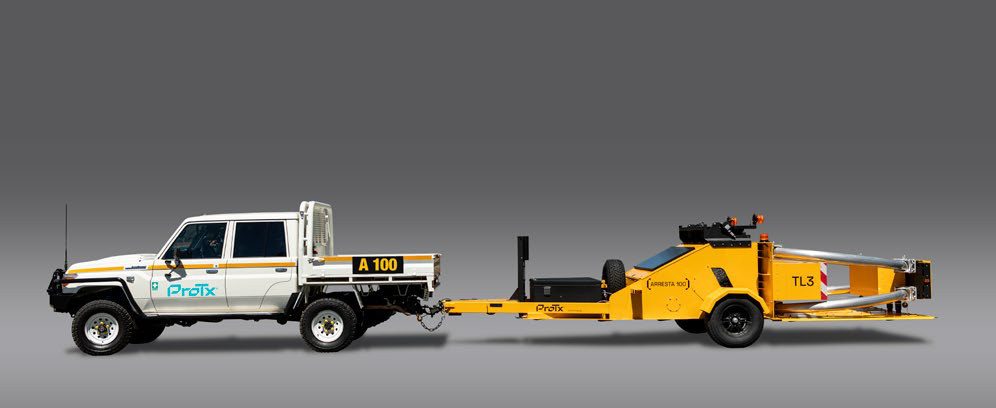
ProTx has developed a seven-metre, towable barrier trailer for short-duration maintenance, utilities and incident-response jobs — with the ultimate goal of saving road workers' lives.
Brisbane-based startup ProTx was founded to solve a practical and serious road safety problem: temporary worksites still rely on humans working metres from live traffic, protected only by signs, cones and conventional barriers that were not designed to stop a 2-tonne vehicle.
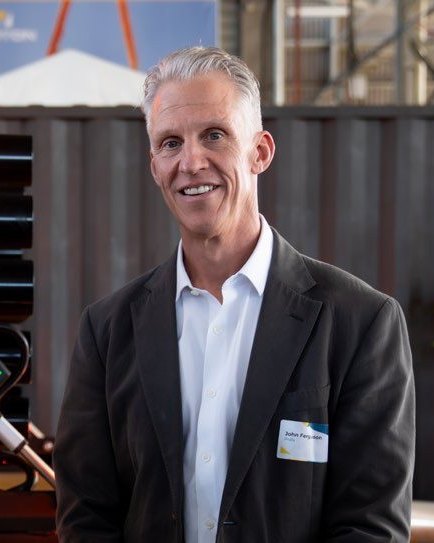
For John Ferguson, founder of ProTx, the problem became personal through his earlier work in hostile vehicle barriers. Between 2018 and 2020, John worked on barrier deployments for major events including the Gold Coast Commonwealth Games and Invictus Sydney, bringing him into contact with crews, companies and individuals directly affected by roadside deaths.
He heard stories of workers killed doing routine traffic management, including families who had lost loved ones on the side of the road. The question that stayed with him was simple: why, in this day and age, were so many workers still being hit and killed while doing their jobs?
The technology
ProTx, founded in 2020, has developed a practical physical barrier that road crews can deploy quickly and use at temporary worksites. The product, called Arresta100, is a seven-metre, two-tonne barrier trailer that can be towed by a standard work ute and made operational in minutes.
The innovation sits in the way the barrier absorbs and dissipates collision energy. The first part of the unit is the cassette: a sacrificial, energy-absorbing assembly designed to be unbolted and replaced after an impact.
The second part is the reusable main body of the trailer, heavy-duty steel designed to be inspected and reused after a crash. Instead of relying only on the mass of a truck, the barrier uses the mass of the impacting vehicle and friction to help stop the vehicle safely.
The solution
ARM Hub entered the ProTx journey as John moved beyond early proof-of-concept testing. ARM Hub's role was to help translate a locked, crash-tested design into a product that could be assembled repeatedly, cost-effectively and at scale.
The impact
ProTx has moved from invention to approved product, with its first production unit handed to one of Australia's major road maintenance companies as its first customer and go-to-market partner.
Motorists travelling through the Hogan Road and Tunnel network may begin to see the Arresta100 roadside in coming months: a seven-metre barrier keeping road crews safe without putting another worker in harm's way.
First deployments
Arresta100 launched formally on 3 June 2026. The first units are being deployed by Ventia on the Transurban Hogan Road and Tunnel network in South East Queensland, pending DTMR authority, with further deployments planned for Ramsey, Port of Brisbane, and airport sites.
For Ventia, one of Australia's largest infrastructure services companies, the decision came down to a straightforward safety case.
Annual roadside worksite incidents — Australia
18Fatal crashes
245Serious injury crashes
530Minor injury crashes
Source: Austroads, National Harmonisation of Temporary Traffic Management Practice: Benefit–cost Analysis, Publication No. AP-R678-22, published 5 September 2022
What ARM Hub helped solve
Assembly process: What to keep in-house, what to outsource, and how to assemble consistently at volume
Facility layout: Configured to support 10-20 units in year 1 and 50 units in year 2
Procurement and inventory: A system that could hold up as production increased
Cost and labour: Labour costs modelled and reduced to hit targets
Production targets
June 26: Formal market launch
20: Year 1 production target
50: Year 2 production target
“
ARM Hub's world is manufacturing and leading into manufacturing, so the review was more than just, ‘Think about this.' It actually changed our perspective on how we were designing things. We started designing — and redesigning parts — with manufacturing in mind.
John FergusonFounder, ProTx
John Ferguson, Founder, ProTx
LESSONS
The concern
Backing a promising prototype that never survives contact with real production.
The evidence says
Design to manufacture early, and the prototype and the product become the same thing.
The take away
Ask “how will we build 50 of these?” before you build one.
18 · Opinion · By Samuel Jesuadian
AI in bio-medtech
Why validation is the real bottleneck
Samuel Jesuadian, Chief Commercial Officer, ARM Hub
Artificial intelligence has transformed drug discovery and development, but the industry faces a critical bottleneck: validation. AI-accelerated drug design keeps advancing, yet preclinical and clinical validation still rely on manual, time-intensive processes. That gap is ARM Hub's opportunity: to lead as the market's integrator and enabler, helping others turn AI-generated science into validated, trusted results.
Real acceleration comes from automating laboratory operations and validation workflows. Self-driving laboratories, automated lab systems, and AI-powered experimental design are the next frontier: technologies that turn AI-generated hypotheses into evidence regulators can trust, faster. Just as critical is trusted AI: systems built for explainability, interpretability, and auditability across the validation pathway. Australia's strength in low-volume, high-value therapeutics and personalised medicine gives us a natural edge in building AI and automation models suited to this niche.
The integration opportunity extends across the value chain. Contract Research Organisations (CROs) and Contract Development and Manufacturing Organisations (CDMOs) increasingly recognise that fragmented data and siloed execution systems undermine efficiency. Multi-site trials, distributed manufacturing, and clinical oversight demand seamless data federation, unified visibility, and standardised governance. The platforms that solve this, enabling data interoperability, end-to-end execution transparency, and cost and timeline optimisation across the ecosystem, will capture disproportionate value.
For biopharmaceutical manufacturers, the shift is more fundamental: building digital factories. AI-driven bioprocess optimisation, real-time process analytics, and predictive quality systems all require foundational data architecture and governance. Companies are moving towards a single source of truth across their operations, from upstream bioprocessing through to supply chain. Physical vision systems, combined with trusted AI for anomaly detection and predictive maintenance, are seeing rapid adoption precisely because they drive immediate, measurable productivity gains.
ARM Hub's role is to embed this capability into the market ecosystem, in two complementary ways. First, we support early-stage companies to design manufacturability and digital readiness into their product architecture from inception, building quality management (QMS), enterprise resource planning (ERP), and customer relationship management (CRM) infrastructure before revenue generation begins. Generative AI applications in regulatory documentation, protocol synthesis, and process design acceleration are integral to this support. Second, we actively develop and validate AI and automation solutions for sector-specific constraints: multi-site trial orchestration for CROs, process optimisation for CDMOs, and predictive systems for manufacturers.
Australia's market structure, characterised by low-volume, high-value therapeutics and deep expertise in personalised medicine, creates a natural laboratory for developing contextualised, adaptable AI models that can scale internationally. ARM Hub's position within Australia's national AI Adopt Centre network enables us to lead this space, while maintaining our core commitment to commercialisation support and early-stage technology development.
The companies winning in this space will be integrators, not specialists. ARM Hub's role is to be that integrator for Australian bio-medtech.
19 · Feature
Medical & AI advances
AI is changing Australian medical research, and it has moved well past being a tool for admin.
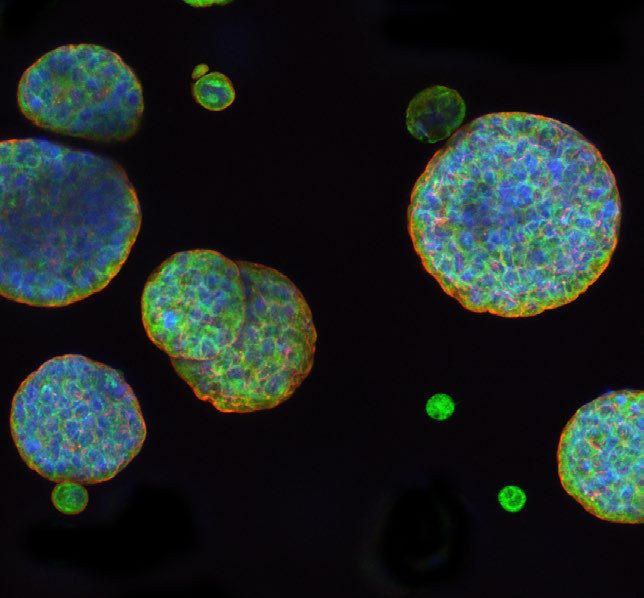
Liver Organoid, Gelomics
It now sits at the centre of the work: finding new drugs, diagnosing disease faster, and reading tissue samples with a precision no human eye can match. Here are four examples, each solving a problem that used to slow everything down.
Australian biomedical AI platforms
Brisbane-based Gelomics exemplifies “physical-plus-digital” biomedicine, combining 3D human tissue engineering with an AI platform that plans experiments, summarises literature and optimises protocols in the cloud. Human cells embedded in proprietary hydrogels are formed into functional microtissues, such as beating cardiac tissue and liver structures, in about 10 minutes instead of roughly four hours, with pharmaceutical clients reporting around 15 per cent fewer animal tests and about 20 per cent cost reductions in preclinical programmes.
Microbio's InfectID-BSI assay targets sepsis, detecting 26 bloodstream pathogens directly from a single 0.5 mL blood sample in under three hours versus the usual 24 to 48 hours for culture, achieving a 99.7 per cent negative predictive value.
ARM Hub's AI data platform ingests heterogeneous trial data, from clinical notes to lab documents across 22 markets, and standardises it for plain-English querying, supporting Microbio's global trials and its FDA 510(k) submission pathway.
New Australian biomedical AI exemplars
At WEHI and the Royal Melbourne Hospital, researchers are mapping diseased tissue cell by cell, measuring what each cell is doing while keeping it in place, so they can see which cells sit next to which. This is known as spatial omics, and it produces far more data than anyone can read by eye, so AI turns those maps into practical diagnostic tools that fit into everyday pathology.
At the University of Queensland, researchers are building the world's largest 3D total skin imaging database and pairing it with AI decision support so clinicians can detect melanoma earlier, including for patients in regional centres who access imaging hubs rather than specialist dermatology clinics.
Key takeaways
AI is now part of the core equipment for Australian medical research, the way the microscope once was.
The pattern repeats in every story: AI does the reading, sorting and flagging. People make the decisions.
Clean, structured data is the entry ticket. Every result on this page started there.
The benefits are countable: hours saved, tests avoided, costs down, answers sooner.
20 · Impact Study · Microbio
Saving lives with sepsis testing
Professor Flavia Huygens, Chief Scientific Officer, Founder and Executive Director at Microbio
According to a 2020 Lancet study, sepsis kills roughly 11 million people a year, and the bottleneck has always been diagnosis. Standard culture takes 24 to 48 hours. Microbio's InfectID-BSI reads a single half-millilitre blood sample and identifies 26 pathogens in under three hours, with a 99.7 per cent negative predictive value.
Behind the test sits a data problem. Microbio runs trials across 22 markets, and every market produces information in a different shape. ARM Hub's AI platform pulls it into one structured source that the team can question in plain English. That single spine supports the global trials and the path to FDA approval.
The next phase moves the platform from receiving secondary data to collecting primary data direct from trial sites. “At the moment, we are making some refinements before going into actual testing where we will move from receiving secondary data to actually collecting primary data,” said Charlotte Birkinshaw, AI Engineer at ARM Hub. The work covers portal usability, workflow alignment and automated processing of run files, so sites can upload data easily and consistently.
“This phase will be driven by human feedback,” Birkinshaw said. “What they think of the platform, how it works with their actual processes and what can be improved.”
“The data foundation we built with ARM Hub enables Microbio to run clinical trials across many markets with a lean team, and keep our focus where it counts, on getting a faster, more accurate result to the clinician,” said Flavia Huygens, Executive Director, Founder and CSO at Microbio. “As we move toward global commercialisation of the InfectID-BSI product, that capability is what will let us grow without losing what makes the science work.”
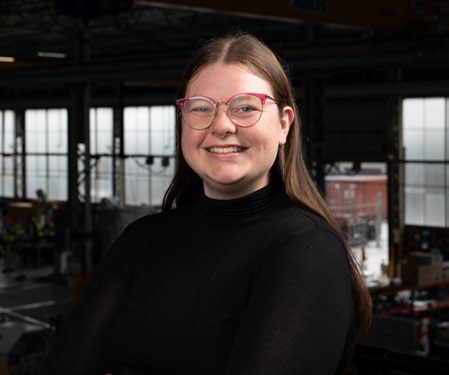
Charlotte Birkinshaw, Software/AI Engineer, ARM Hub
3 hrsto identify 26 sepsis pathogens, against 24 to 48 hours for standard culture
99.7%negative predictive value, catching pathogens cultures miss
22global markets via 11 distribution partners
LESSONS
The concern
Messy data scattered across systems, and the regulatory risk that comes with it.
The evidence says
One clean, structured source of truth supports growth and keeps regulators satisfied.
The take away
Fixing the data spine first means everything else gets easier.
21 · Impact Study · Gelomics
Cutting animal testing with lab-grown tissue
MCF-7 Tumour
Around 200 million animals are used in research every year, and more than 90 per cent of drug candidates that pass preclinical testing still fail in human trials. Regulators are pushing for alternatives. Queensland company Gelomics grows human tissue in the lab instead. Cells are set in a hydrogel that mimics the protein environment of real tissue, producing working models such as beating cardiac tissue or liver structures. Its laboratory device uses photocuring to form the gel in about ten minutes, down from four hours.
Behind the tissue sits a data platform. Researchers plan experiments in the cloud, where an AI agent summarises the field and machine learning generates the full experimental protocol. ARM Hub's AI Adopt Centre built the infrastructure that lets those models run together securely in the cloud, and helped Gelomics into a Google accelerator to develop a product customers can store data in safely and scale globally.
“The issue is that these models don't translate well to human biology. For example, results from mouse studies rarely correlate with human outcomes. In fact, more than 90% of drug candidates that pass years of preclinical testing still fail in human clinical trials,” said Gelomics CEO Christoph Meinert. “Instead of testing drugs and compounds in animals... we can actually generate tissues that look, feel, and behave and react to drugs just like real human tissues in the lab.”
The platform has been tested by 300 researchers across 23 countries, including Australia, New Zealand, Singapore, the United States, Japan, Germany, Switzerland and the United Kingdom. “Pharma companies we work with were able to reduce animal testing requirements by an estimated 15% and associated cost by 20%,” Meinert said. “At a high level, success means a significant reduction in unnecessary animal testing. That's a core part of our mission.”
24xfaster tissue, from around four hours down to about 10 minutes
15%fewer animal tests reported, with around 20% lower preclinical cost
300researchers using the platform across 23 countries
LESSONS
The concern
Complex tools that waste time and money without lifting quality.
The evidence says
Let AI do the repetitive planning and reading, keeping experts free to make valuable judgement calls.
The take away
The value shows up as hours and dollars saved, and it's measurable.
22 · In Summary
Follow the Data: What the case studies show
This document covers six businesses and four people who do this work every day. None of the businesses started as an AI company. Every one started with a problem and a fair doubt about whether the technology was worth the risk.
For most of the last 30 years, efficiency has meant a trade-off. You could cut costs, hold quality or keep prices down, and you could usually manage two of the three. The businesses in these pages are finding that trade-off has loosened.
AMCA's SWMS generator brings a compliant safety document down from four hours to under 15 minutes. Yamagigu turns two days of digging through old proposals into a first draft in about 10 minutes. Gelomics forms tissue models in 10 minutes rather than four hours, and its pharmaceutical clients estimate preclinical costs about 20 per cent lower.
The cost came down and the quality went up because the technology took on the reading, sorting and checking that used to consume skilled people's hours. Those hours went back into work that earns money. Here is what the evidence says, worry by worry.
Trust comes from your own data.
Distrust is the biggest barrier to adoption in Australia, and it is a fair one. AMCA built its assistant only on documents it had already approved, so every answer traces back to a source. In medtech, Sam Jesuadian makes the same point from another angle: AI can speed up the science, but results only count once they can be validated and trusted. Ask whether an answer can be checked against material you already stand behind.
Design to manufacture before you prototype.
ProTx's Arresta100 went from proof of concept to a product Ventia took on as its first customer. It got there because assembly, facility layout, procurement and labour cost were worked through before the first production unit was built. Ask how you will build 50 before you build one.
Your operating data is an asset.
Imported automation is built for plants that run one line all day. Australian plants run several and switch between them. Dr Troy Cordie's advice is to capture data about how your floor actually works now, before you know what you will build with it.
Clean data beats clever tools.
Yamagigu's knowledge sat in thousands of past projects nobody could search. Microbio had trial data from 22 markets in 22 shapes. In both cases, structuring the data was the real work, and the tool on top was the cheaper part.
Start small, and attach a decision.
Harcourts mapped five workflows, scored each for value and difficulty, and chose the easiest valuable one to build first. Corrie Germin runs projects in stages with go/no-go checkpoints. Dr Roozbeh Derakhshan agrees on how a proof of value will be judged before it starts, then proceeds or stops. Being willing to stop can matter as much as being willing to scale.
People stay in charge.
In sepsis testing, the machine flags and the clinician decides. At yamagigu, the system compiles the first cut and consultants still refine it. The technology wasn't that hard: culture, ownership and finding the time was the main challenge.
23 · Professor Cori Stewart FTSE, Founder and CEO, ARM Hub
Keep what you know
The national AI conversation is full of big ideas: sovereign AI, data centres, AI agents, open weight models, skills. ARM CEO Professor Cori Stewart FTSE on what each one means for a business like yours.
Professor Cori Stewart, Founder and CEO, ARM Hub
Spend a week listening to government talk about AI and you'll hear the same handful of ideas: Data centres, agents, open-weight models, skills and sovereign AI. They sound big, but each one lands somewhere practical, and the businesses in these pages are already there.
Sovereign AI starts with what you already know
For a while, sovereign AI meant Australia doing things like building its own ChatGPT and yes, we can and do make foundation models; but we've moved on from that, partly because of open-weight models. With a proprietary tool like ChatGPT, you can drive it, but you can't lift the bonnet. An open-weight model comes with the bonnet up, so a business can run it on its own systems and, depending on the licence, tune it using its own information.
That changes the question to which part of AI we actually need to own. For most businesses, the answer is data.
Yamagigu had 11 years of past projects that nobody could easily search. Once that knowledge was structured, a two-day job became a first draft in about 10 minutes. Our Director of Industry Research, Dr Troy Cordie, makes the same case for the factory floor. Capture how your plant actually works, and the intelligence you build on top belongs to you.
The detail in the data
Australia is attracting serious data centre investment, and we need the compute. But the number of data centres is a poor scoreboard. I'd rather count products made here, exports and jobs.
On that measure, these pages score well. ProTx has a road safety barrier with a major infrastructure company as its first customer, and production targets of 20 units, then 50. Microbio's trial platform spans 22 markets. Gelomics' tissue platform is used by researchers in 23 countries.
But compute costs money, and you'll hear it measured in tokens. A token is a small chunk of text, often a short word or a piece of a longer one. AI tools read your question and write their answer in tokens, and most services charge by the token, a bit like a taxi meter. Send a 100-page manual when the answer sits on one page, and the meter runs faster. It's one more reason clean, well-organised data pays for itself.
The next wave of AI takes action as well as answering questions. It can check stock, raise an order or book a machine inspection. Governments are right to ask who stays in control.
You wouldn't give a new employee the keys to the bank account on day one. Decide what an agent can see, what it can do and what needs a person to sign off. Good governance is what lets you use more powerful tools with confidence.
Better tools for the people you have
Manufacturers can't find enough skilled people, and a lot of know-how is close to retiring. AI can help keep knowledge in the business. Picture an apprentice at a machine, asking a question and getting an answer straight from the company's approved manuals.
Our rule at ARM Hub is simple: the business problem comes first, then the data, then the AI. Pick one problem that costs you money. Find the data around it. Start small enough to prove value, and build with scale in mind.
Start with a problem worth solving.
Australia's opportunity is businesses using AI to get better, and keeping the knowledge they create here in Australia. This means not selling it to someone else who can aggregate the data and eventually do your business better than you. The businesses in these pages have already started.
“
. . . the business problem comes first, then the data, then the AI.
Professor Cori StewartFounder and CEO, ARM Hub
How a first project usually starts
Start with a problem worth solving.
Over 21 months, the AI Adopt Centre has worked directly with more than 300 businesses and run 73 roadmap workshops. The pathway is simple:
01
A readiness assessment to establish where you stand
02
A co-design workshop with the people who do the work
03
A roadmap that names one small first project, with a clear point to proceed or stop
None of the businesses here needed an AI expert on staff. If you're ready to take the first step, get in touch.